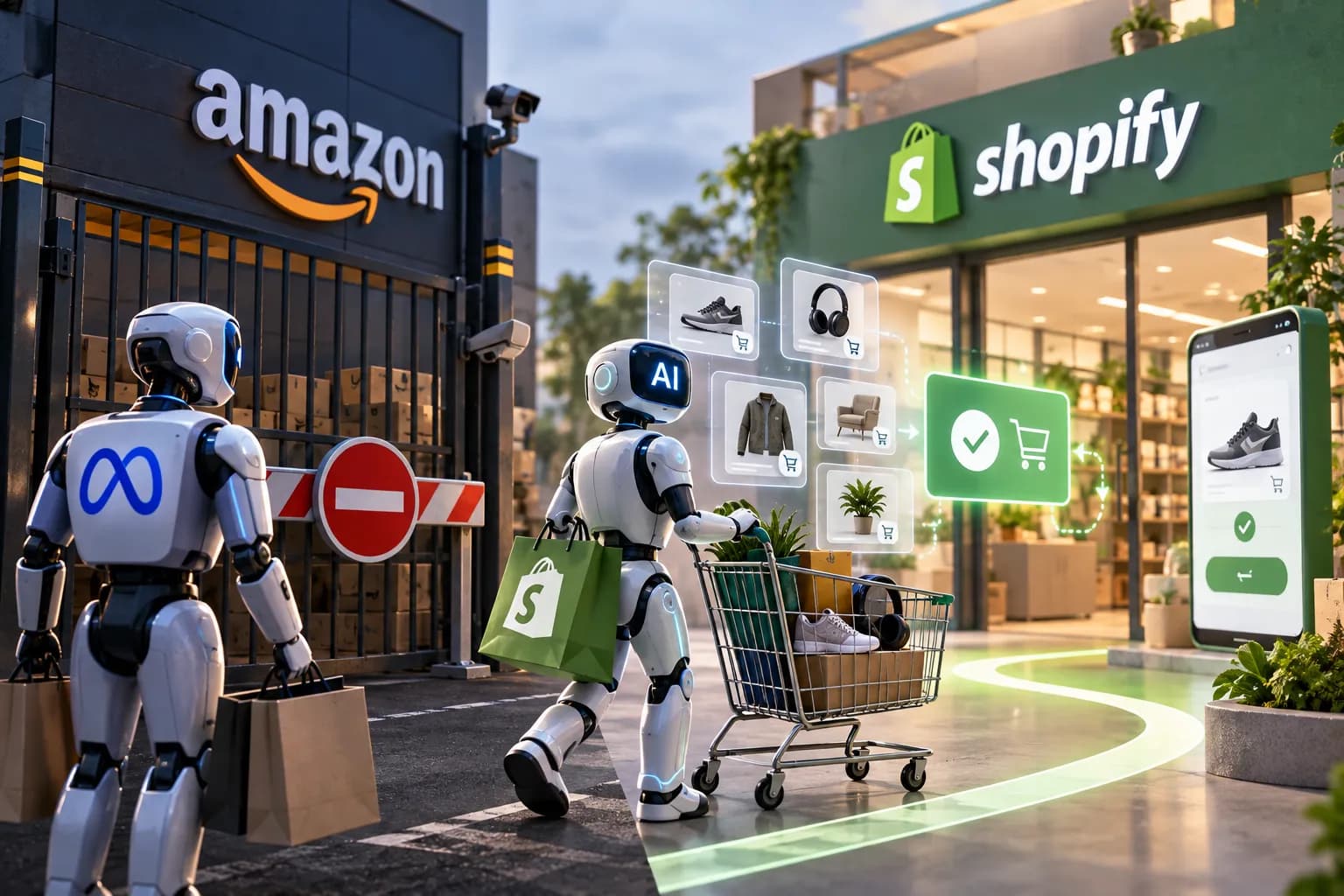

The War for the Future of Online Sales Has Begun: Amazon Blocks Meta's AI from Shopping, While Shopify Embraces the Change
This new development is not merely a simple conflict between three corporate giants; rather, it raises a much more crucial question: In the era of AI Agents, who will control the relationship between the buyer and the seller?
The Conflict Between Meta and Amazon Meta’s AI, known as Muse, is not just a regular chatbot; it is a Personal AI Agent capable of searching, filling out forms, and making purchases on behalf of the user with prior consent. However, Amazon has not allowed Muse to make purchases on its platform. Amazon's justification is that Meta did not notify them in advance, the agent does not identify itself while searching, and there are underlying security and data privacy concerns. In response, Meta emphasizes that Muse does not have access to users' passwords or financial information, and that all data is securely protected.
Shopify’s Open Strategy Unlike Amazon, Shopify has chosen a more open path and fully supports the purchasing process through Meta. Shopify stores can allow buyers to discover products and complete their purchases directly within the Meta experience. Additionally, Shopify has activated "Agentic Storefronts," making sellers' products easily discoverable across various AI channels such as Google, Gemini, Microsoft Copilot, and ChatGPT.
A Revolution in the Marketing Equation This shift has a much larger impact on marketing itself. Until now, the buyer’s journey in e-commerce revolved around: (Seeing an Ad → Clicking → Visiting Website → Searching → Comparing → Buying) But AI agents can bypass most of these stages. A user simply has to say: "Find me the best running shoes for under $150." The agent then searches for the products, compares them, and, with the buyer's consent, completes the transaction.
A New Challenge for Brands and a Threat to Amazon This raises an important question for brands: If AI is deciding the product selection, how do you ensure it chooses your product? This development will fundamentally change concepts like SEO, product discovery, and even brand identity. In the future, brands will not only compete for human attention; they will also need to structure their data, pricing, reviews, and product information in a way that AI can easily understand and recommend.
This issue is particularly sensitive for Amazon because it is not just a storefront; it operates a massive advertising business. If buyers no longer go to Amazon to search and compare, and the AI does it instead, the visibility of ads and "Sponsored Products" will drop significantly. This poses a major threat to its advertising revenue model.
Ultimately, this war is about one thing: In the future of E-commerce, who will stand between the buyer and the brand? The online store, the search engine, social media, or the AI agent? Amazon is trying to keep this relationship within its walled garden, while Shopify aims to position itself at the heart of this new world where AI becomes the primary buyer.